

Dear Church Leaders,
***Important: If you have not read my previous letter to Church Leaders, please start with the one titled “when shepherds look away” and then proceed to this one.
In the same spirit of my previous letter, I hope to share some insights on the ways in a which a shepherd/leader can exhibit the love and compassion of Jesus to those in their congregation.
When a survivor tells you their story, you are stepping onto holy ground. Not because the story is tidy or inspirational, but because it is sacred. It is the place where someone’s body, safety, and voice were taken from them…and they are choosing to trust you with their truth.
If I’m being brutally honest, I’ve had my share of interactions with faith leaders of all sorts and I’ve often left these interactions feeling unseen and completely disregarded, even by people I consider friends. It has hurt, partly because it’s usually with people I thought were safe, but also because I realize how common this is and how many deal with it. I think these people do mean well in many cases, but without a trauma informed mindset, even the best of intentions can do more harm than good.
It’s fair to say that unless you have been through something like this, it’s hard to always know how to respond. With that in mind, I would gently suggest it is on us as representatives of Jesus to learn how to better “bind up the brokenhearted, to proclaim freedom for the captives and release from darkness for the prisoners.” Isaiah 61:1
That said, I recently reached out to a pastor from my childhood church as I prepared to go public with my story of sexual assault. His response was polite, but it was another reminder of how often people, especially church leaders, are not informed of their approach. It was this exchange (and the many others) which inspired me to write this. I’m not writing this to be petty or call people out. My heart is to speak to my perspective on this side of it and how we can do better.
If you are a pastor, leader, mentor, or simply a human who cares about people, these are some evidence-based, trauma informed principles every survivor deserves.
1. Start with Belief:
Survivors brace themselves in most interactions. The safest words you can offer are simple.
“Thank you for trusting me.”
“I believe you.”
Doubt doesn’t make you objective, it makes you unsafe.
2. Validate the Pain:
Validation doesn’t mean you know every detail or remember every moment. It means you acknowledge the impact and the pain.
“What you went through was wrong.”
“Your feelings make complete sense.”
“I’m sorry this happened.”
Never minimize
Never redirect
Never say, “try to remember the good”
Trauma doesn’t disappear because time has passed or because there may be some good memories mixed in.
3. Avoid Spiritual Bypassing:
In Christian culture, this is one of the most damaging missteps and unfortunately very common in faith settings.
Spiritual bypass sounds like:
“God is faithful”
“Focus on the good memories”
“Forgive and move on”
or my personal favorite…
“This is an attack from the enemy”
These phrases might feel comforting to the speaker, but they silence the survivor, even if they are true statements. These types of responses by spiritual leaders can create secondary trauma or delay healing.
4. Name your Role (Even if it’s Small):
Many leaders shy away from acknowledging institutional failure. But responsibility is not the same as blame.
A trauma informed response sounds like:
“I’m sorry we didn’t protect you.”
“If I missed something back then, I regret that.”
“We should have done better.”
This is humility,
This is healing.
It’s not assigning blame but witnessing their pain.
5. Let the Survivor Set the Pace:
Trauma is a loss of control.
Choice is the beginning of healing.
Ask:
“Would you like to share more?”
“How can I support you?”
“Is this something you need prayer for, or do you need me to just listen?”
Don’t pressure for details.
Don’t rush the story.
Don’t make it about your discomfort.
6. Be Careful with “I Don’t Remember”:
It’s absolutely ok to not remember, especially if it’s been a long time. What matters is how you communicate it.
Trauma informed:
“I don’t remember every detail, but I am deeply sorry for what you experienced.”
Trauma avoidant :
I don’t remember, so I can’t be involved, Merry Christmas”
Memory loss is never a reason to bow out of compassion.
7. Don’t Bring God Into Language Without Consent:
For many survivors, faith is a part of their healing. For others, it is part of their pain.
Ask first:
“Would scripture or prayer feel supportive, or would you prefer that we stay with your experience right now?”
Consent matters spiritually just as much as it matters physically.
8.Keep Yourself Out of the Center:
This moment is not an invitation for memories, self-defense, or emotional comfort.
Avoid:
“This is hard for me to hear”
“That’s not how I remember it.”
“He was always so kind to me”
Their pain is not about your memory or personal experience.
9: Acknowledge Institutional Impact:
Abuse rarely happens in isolated incidents. Silence from the community, pastoral decisions, and system failures make the harm worse.
A healthy leader would say:
“Our structure failed you.”
“We should have created a safer environment.”
“We are committed to doing better.”
I cannot stress enough that accountability is holy work.
10: Follow up:
Someone trusting you with their story, is not a one-time event. It’s an open door.
Simple follow up messages can include:
“You matter.”
“I’m here.”
“Your story is not too much for me.”
“I’m here if you need help taking the next steps.”
Survivors will brace for backlash or negative responses. But silence is one of the deepest wounds survivors talk about. I experienced it myself when I first wrote my story. I was prepared for backlash, but I was not prepared for the many who would never acknowledge my story.
11. Even if you (or your church/institution) had nothing to do with the abuse, your response still matters.
One of the most painful experiences survivors describe is when someone says,
“That wasn’t under my leadership”
“That happened before my time”
“I wasn’t involved, so I can’t speak to it.”
“That wasn’t our church’s fault.”
These responses may feel factual to the speaker, but they can leave the survivor feeling dismissed. As previously stated, silence is equally hurtful.
Trauma doesn’t care about your job title or timeline. Survivors aren’t asking you to answer for something you didn’t do, they are asking you to acknowledge what was done and acknowledge their pain.
Acknowledge the harm, even if it wasn’t on your watch.
“Even though I wasn’t here when this happened, I am so sorry for what you experienced.”
“What you went through matters. Your story matters and the impact is real.”
“Regardless of when this happened, the church should have been a safe place for you.”
“How can I support you now?”
Trauma informed leaders don’t hide behind dates or job roles. Compassion matters.
WHY IS THIS IMPORTANT?
When survivors encounter genuine care instead of defensiveness, healing happens faster.
When they encounter dismissal, especially from people not involved, the wound deepens.
12: Don’t Jump Straight to Legal Talk (Unless The Survivor Initiates it).
Many leaders, especially pastors, board members, or administrators feel panic when someone discloses abuse.
Their mind goes to:
“Mandatory reporting”
“Who is liable?”
“Was this documented?”
“We need to talk to the insurance company”
“Let’s not say too much”
This reaction might seem wise from an administrative standpoint, but to a survivor it lands as cold, self-protective, dismissive and very often re-traumatizing.
Survivors do not come forward asking organizations to protect themselves, they come forward needing care, truth and humanity.
There is a time for legal steps.
There is a time for reporting.
There is a time for accountability.
The first response should never be a legal one. It should be compassion and presence.
Leading with legal language communicates that the institution is the priority, not the survivor. And let’s be honest, all too often the institution usually ends up being the priority. Leading with empathy communicates that the survivor is safe, seen and valued, even if formal steps need to be followed.
Humanity should always come before liability.
Why does all this matter??
When someone shares their trauma with you, they are not asking you to fix it. They are asking for a witness to their pain. They are looking for you to respond with courage instead of fear. They are hoping you will acknowledge the harm rather than sugarcoat their experience.
Grief needs a witness.
While I’ve had some less-than-great interactions, I’ve also had many great ones. I’m incredibly blessed to say that my current pastor is one of the exceptions in this area. Ever since he learned of my story, he has been deeply encouraging about my decision to share it. He has spoken with me personally, and most recently commented on my blog.
He wrote:
“Thank you for being bold and courageous in sharing your story that needs to be told. I am also sorry to you and the others that have suffered trauma because perversion was allowed to continue in a place of worship, where kids and teens should be protected and safe, without the worry or experience of being sexually assaulted. I pray that your healing will continue as you help others find hope and healing. We are proud of you”!
I wish I could describe the feeling I had when I read those words. Not only did he acknowledge it in general terms, but he also did it in a public space. To someone who has been through this, that is a true gift.
My Senior pastor is not the only one who has done this. Over the years, many church leaders and pastors at my church have publicly supported me when I’ve shared my story. My hope is that survivors who come across my blog will see that there are pastors who will stand with them.
If that is you reading this, I pray you are encouraged. I also pray you find leaders like this in your own life. Leaders who are willing to listen, acknowledge the truth and stand beside those who have been harmed.
You don’t need a degree to be trauma informed. You just need humility, empathy, and the willingness to keep learning and be present.
And let’s face it, survivors deserve nothing less.
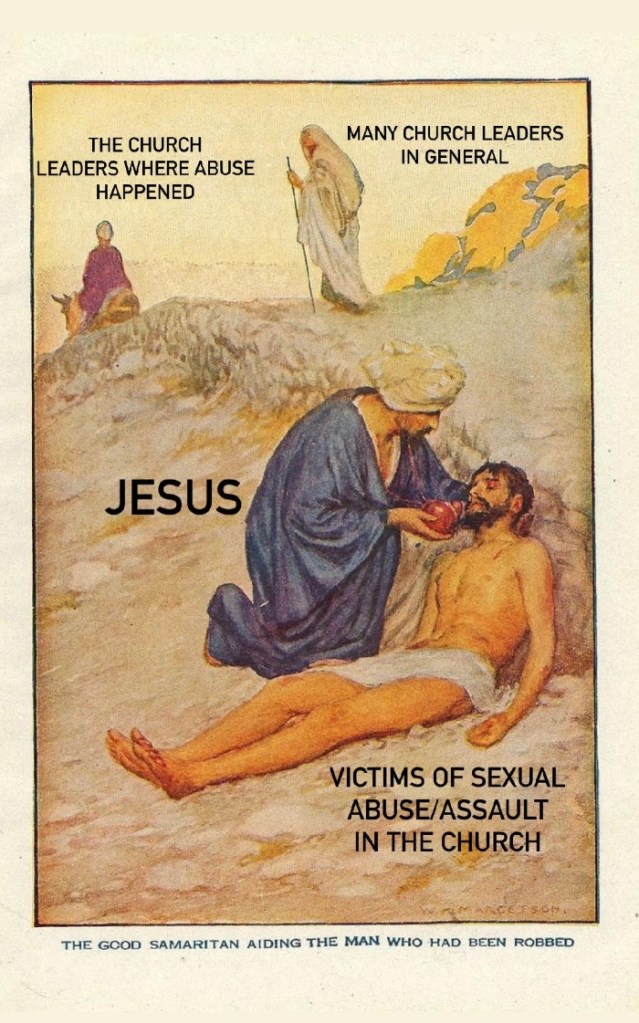
Below is an image that reflects what many survivors experience; being passed by, by those who are unsure how to respond. Yet Jesus never turns away from the wounded. He draws closer. I share this image not as a condemnation, but as an invitation to follow Christ’s example by drawing near to those who are hurting.
“The Lord is close to the brokenhearted and saves those who are crushed in spirit.” Psalm 34:18


 sixtyone7
Leave a reply to Eryn Kismet Cancel reply